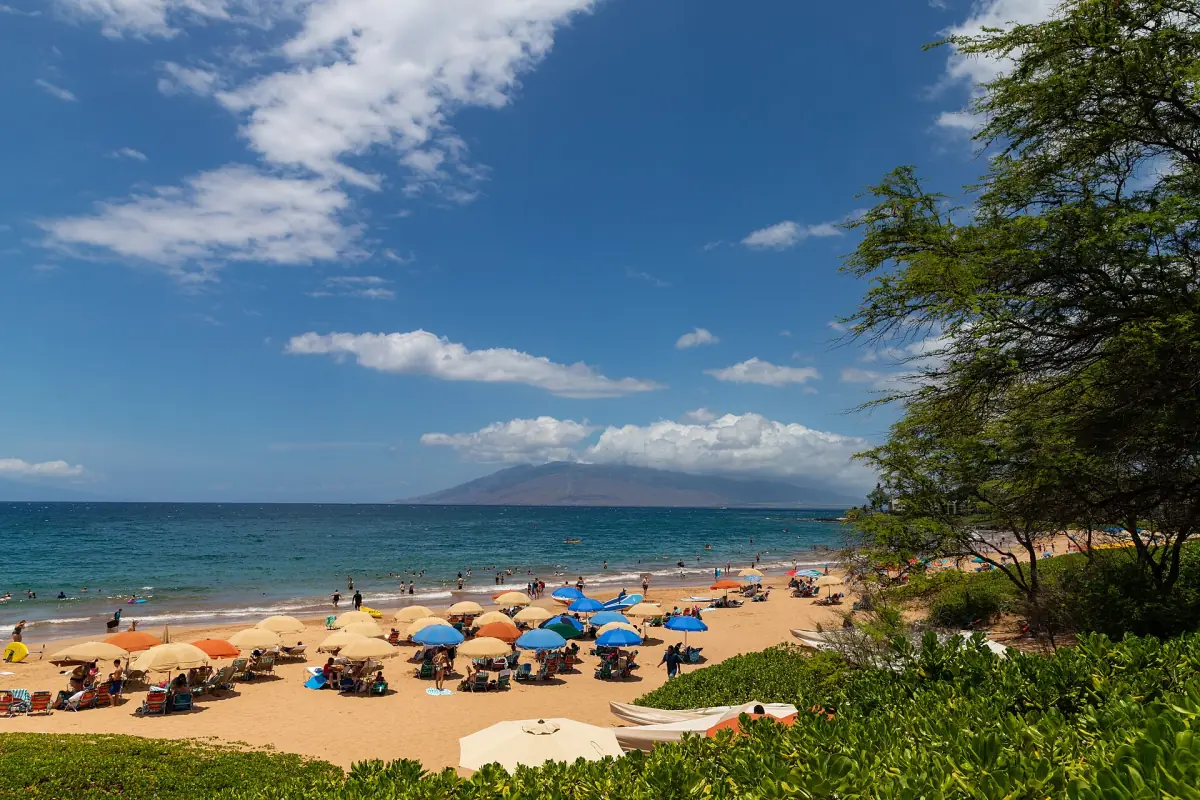
Choosing a base on Maui
The area you pick matters more than the hotel. Maui has four areas that visitors use to plan: West Maui with Kāʻanapali, Nāpili and Kapalua, South Maui with Kīhei, Wailea and Mākena, Upcountry on the slopes of Haleakalā, and East Maui around Hāna. Most flights land at Kahului Airport (OGG) in the center, and every base is a drive from there.
This guide does not list hotels or room prices, because they change by season and by day. It shows what stays the same: the climate, the distance and the rules around each area. Rental cars are in high demand, so reserve yours early.
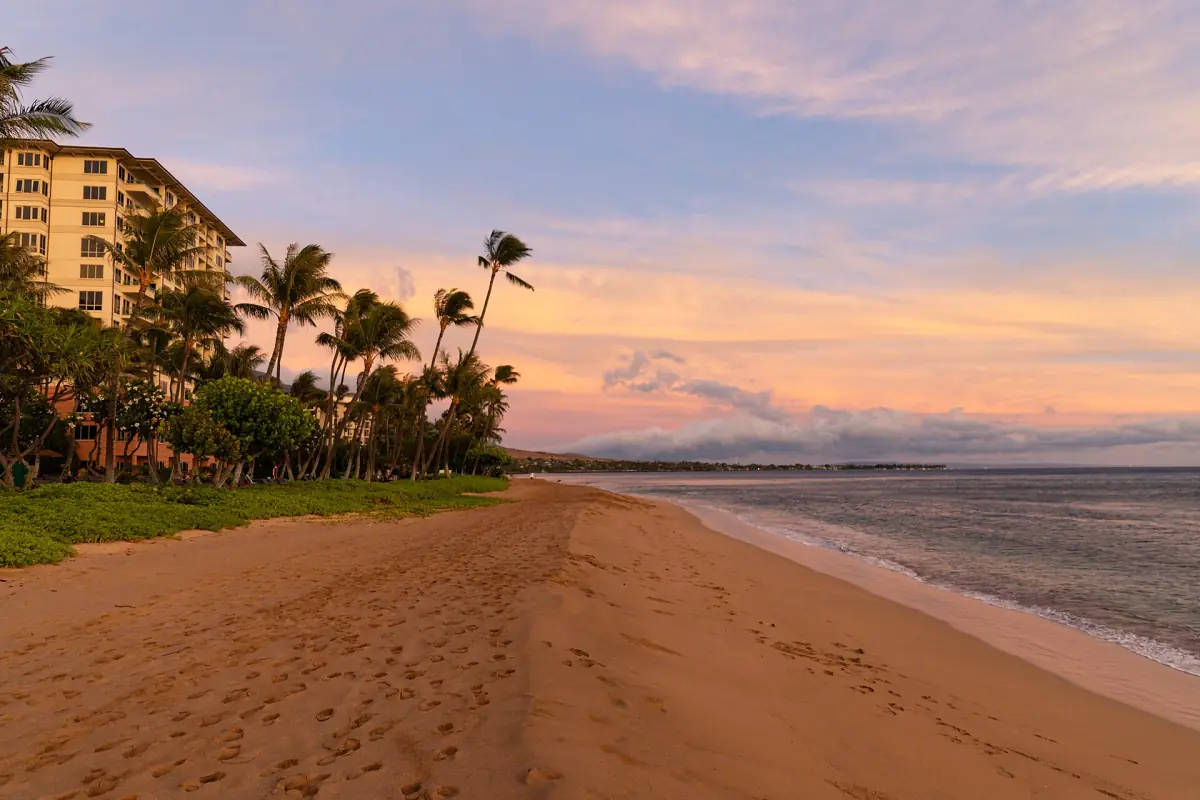
The four areas compared
Which part of the island suits which kind of trip.
West Maui: Kāʻanapali, Nāpili, Kapalua
A resort area about 50 minutes from the airport, with three miles of sand at Kāʻanapali, Black Rock for snorkeling and sunset views. It is wetter than the south, with about 27.8 inches (705 mm) of rain a year. Lifeguard coverage at Kāʻanapali is limited to the tower at Hanakaʻōʻō, so check the ocean conditions daily. Lahaina is open to visitors, with some areas still fenced.
Kāʻanapali →South Maui: Kīhei, Wailea, Mākena
The driest and sunniest part of the island. The official tourism site calls Kīhei family friendly and Wailea the place for fine dining. County lifeguards watch Kamaole I to III, while the beaches in Wailea have no tower. Whales can be seen from shore in season. From here the Haleakalā summit and the Molokini boats are within reach.
Kīhei and Wailea →Upcountry: Kula and Makawao
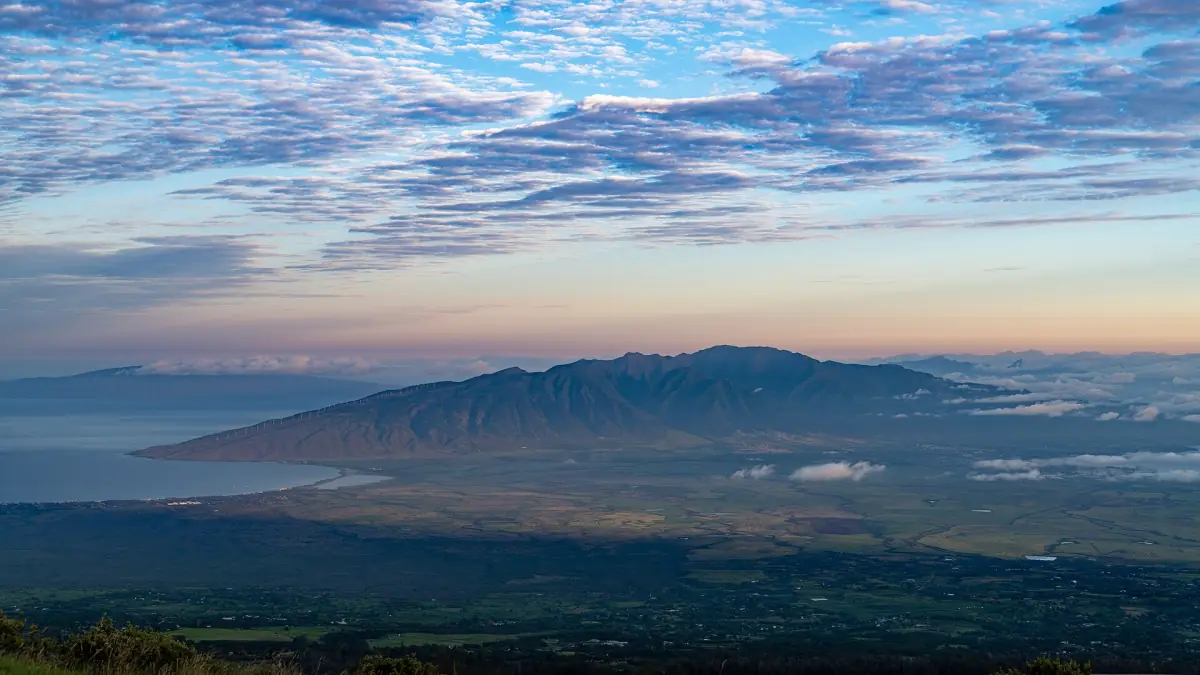
Cooler air on the slopes of Haleakalā and a good base for the sunrise. The park itself has no hotels, shops or gas stations. Camping and cabins inside the park are booked only through recreation.gov. Expect fresh evenings: the high slope near the park ranger station averages 59 to 66°F (15 to 19°C) in the daytime.
Haleakalā →East Maui: Hāna
Remote, green and wet, with about 72.2 inches (1,833 mm) of rain a year. It is 52 miles from Kahului, and the drive takes 2 to 4 hours one way. Gas up in Pāʻia. Camping and cabins at Waiʻānapanapā cost $30 and $100 per night for non-residents, and the Kīpahulu campground opens its bookings 30 days ahead on recreation.gov.
Road to Hāna →Maui tours and activities
Molokini snorkel cruises, Haleakalā sunrise trips, the Road to Hāna and luaus, with live prices and availability.
Climate by area
Daytime highs and yearly rain from NOAA normals for 1991 to 2020, using the nearest weather station.
| Area | Station | January high | August high | Rain per year |
|---|---|---|---|---|
| Central (airport) | Kahului Airport | 82.2°F (27.9°C) | 89.9°F (32.2°C) | 16.2 in (412 mm) |
| West Maui | Kapalua | 79.0°F (26.1°C) | 86.2°F (30.1°C) | 27.8 in (705 mm) |
| South Maui | Mākena | 80.1°F (26.7°C) | 87.3°F (30.7°C) | 15.7 in (399 mm) |
| Haleakalā slope | Ranger Station, 6,962 ft | 61.0°F (16.1°C) | 66.1°F (18.9°C) | 42.2 in (1,073 mm) |
| East Maui | Hāna | 77.8°F (25.4°C) | 82.9°F (28.3°C) | 72.2 in (1,833 mm) |
The summit of Haleakalā at 10,023 feet is colder again, with daytime highs of 50 to 65°F (10 to 18°C) and frost possible all year. For month-by-month values see the weather guide.
Taxes, fees and short-term rentals
Since 1 January 2026 the state lodging tax (TAT) is 11%, up from 10.25%, and 0.75 percentage points of it are the new Green Fee. Maui County adds 3% on top, and the general excise tax comes on top of that. Resort fees vary by property, so compare the total price at checkout rather than the nightly rate.
The rules for vacation rentals in apartment zones are changing. Before you book one, ask the host for the current booking status of the unit and read the cancellation terms.
Hurricane season runs from 1 June to 30 November, and autumn 2026 has been active. Storms passing south of the islands caused power cuts in parts of West Maui and Upcountry in late September. A flexible rate with free cancellation is a sensible choice in this season.
Which area for which trip
A quick guide by travel style.
| You want | Choose | Why |
|---|---|---|
| Long beaches and sunsets | West Maui | Kāʻanapali and Black Rock, about 50 minutes from the airport |
| The most sun and dry weather | South Maui | Driest area, rain of 10.8 inches a year in Kīhei |
| An early start for Haleakalā | Upcountry | Closer to the summit road, cooler air |
| Quiet and rainforest | Hāna | Remote and green, but 2 to 4 hours of driving each way |
| An early or late flight | Near Kahului | Short transfer to the terminal |
Where to stay in Maui: frequently asked questions
Where is the best place to stay in Maui for first-time visitors?
West Maui and South Maui are the usual choices, because both have long beaches and resorts. South Maui is drier and sunnier, West Maui has Kāʻanapali and Black Rock. Both work as a base for day trips by car.
Is it better to stay in Kāʻanapali or Wailea?
Pick Kāʻanapali for a long beach with sunset views and Wailea for dry weather and a quieter feel. Wailea beaches have no lifeguard tower, and Kāʻanapali has one at the north end. Check the conditions daily in both places.
Where should I stay for the Haleakalā sunrise?
Upcountry is closest to the summit road. You can also drive up from South Maui or West Maui with an early start. The sunrise reservation is required from 3 to 7 am and costs $1 per car.
Do I need a car if I stay in a resort?
Yes, for most trips. Rental cars are in high demand, so book early. There is no public transport to the Kīpahulu part of Haleakalā National Park.
What taxes are added to hotel prices in Maui?
In 2026 the state tax is 11% and Maui County adds 3%, plus the general excise tax. Resort fees come on top at some properties.